Luxexcel and Materialise Partners to Establish fully Automated Online Ordering Process
Luxexcel, the inventor of Printoptical Technology and provider of customized 3D printed optics solutions, has partnered with Materialise to establish a fully automated online ordering process that is completely streamlined with 3D printing production using Streamics.
Streamics is a central AM automation & control system by Materialise that allows its users to get a grip on the entire additive manufacturing business. The system links people, machines, processes and 3D printing materials.
Traceability in all Prototyping and Manufacturing Aspects
In addition, Streamics offers traceability in all aspects. Whether prototypes are developed or parts are manufactured, Streamics’ components can be used as standalone features or integrated with other processes and business software.
With the support of the Streamics Robot, CAD files are automatically analyzed, part properties are generated to enable instant quoting, and designs are prepared for 3D Printing – 24/7. Streamics helps to optimally manage the quote-and-order data and connect the new online business efficiently with the 3D printing production back-end.
Supporting Luxexcel’s Online Business
To scale up business and serve it’s global customers within a variety of industries, Luxexcel created a new online order environment. The Luxexcel online order platform is integrated with Materialise’s automation and control system Streamics. Luxexcel has obtained the necessary automation and process control to ensure that customers from all over the world consistently and punctually receive quality parts while Luxexcel’s printed optics business continues to grow.
Luxexcel and Materialise: A Strong Combination of Hard- and Software
The partnership between Luxexcel and Materialise will grow, as Luxexcel strives to integrate more automation steps from Materialise’s software platform into its business.
New Luxexcel Lens Design Creator Democratizes the Way Illumination Optics are Made
3D printing technology combined with optics manufacturing is an extremely powerful solution to the rapid prototyping landscape. Dutch Luxexcel, specialized in the 3D printing of optics and optical components, introduced its unique Printoptical Technology to print optical products without visible layering. In order to democratize the way optical products are made, Luxexcel now cooperates with trinckle 3D to develop a range of lens design creator tools that ease the design of custom LED lenses.
“The NEW Design platform bringS optics design within reach of every designer”
The unique lens design creator enables the creation of a custom plano convex or concave lens in seconds. Ready to be ordered. The new tool is available at Luxexcel’s recently launched online order platform. Now every designer, skilled or not, can create his custom, optimized plano convex and concave lenses tailored for his exact application. With many more to follow!
Create your Custom Lens Design
Luxexcel wants to redefine the way optical products are designed and manufactured. The platform of trinckle 3D enables Luxexcel to make this first step to bring optics design within reach of every designer. Instead of creating a CAD file yourself, the lens creator will automate most of the work, without the costly commitments and time losses you usually may have.
The Luxexcel Lens Design Creator – How does it work?
In order to get a custom 3D design of a plano convex or concave lens, basic optical values like focal length and lens diameter must be entered in the specific fields. Once the file is created and saved, it will be available in a personal gallery. In this gallery your design is ready for ordering and, within only 5 business days, the custom lens are printed and shipped to the customer.
“The lens creator tool WILL democratize the way ILLUMINATION optics are maDE”
The lens creator tool is complementary to the recently launched online ordering platform and democratizes the way optics are manufactured. It is also possible to upload your own custom 3D file created in other software programs. The online ordering platform supports most of the used CAD file types.
Here’s a small instructable by Luxexcel that shows how easy the design platform works:
https://youtu.be/YPrdAiA8ctw
A New World of Optics Development
“With our new design tool we want to take the next step in opening up the world of optical development” said Peter Paul Cornelissen, Head of Marketing & Online Business Development at Luxexcel. “Lowering the bar to make use of optimized optics for its application, and taking away the limitations of standard stock products will be a game changer for many designers that use optics in their products.”
Lens Design for Dummies and Professionals
Will the newly launched tools harm the existing optics software business? If we may give it a shot: they won’t. The intention is to make the creation of easy shaped lenses more accessible and to get them manufactured in a less complicated and very fast way.
For more complex designs that require a certain level of expertise, Luxexcel provides a different solution: At the optical Designer Hub you will find independently working optics designers listed that are approved by Luxexcel who can help users out with need for complex lens designs or enhanced custom solutions.
Well, it’s a notable next step in the ongoing digitization of manufacturing processes that are helpful for lighting professionals. We’re curious to see what’s next!
“EDAG LIGHT COCOON”: THE ULTIMATE IN LIGHTWEIGHT DESIGN FOR THE FUTURE
“GERMAN PREMIERE OF THE ADDITIVELY MANUFACTURED EDAG LIGHT COCOON AT IAA FRANKFURT 2015”
At the IAA in Frankfurt, Germany, the EDAG Automotive Engineering firm presents world’s first fully functioning ‘ready-for-approval’ car model. “EDAG Light Cocoon”, including a 3D printed car headlight, illustrates the extensive potential of additive manufacturing in the automotive industry.
3D Printing Automotive Lighting
The EDAG concept car will show what the mobility of the future might look like: additively manufactured, the ultimate in lightweight design, intelligently networked. The innovative car headlight project bears the signature of EDAG’s new light laboratory and is pursuing the objective of further enhancing the luminous power of the LEDs used by means of an active/passive cooling system.
World’s first fully functioning ‘ready-for-approval’ car headlight model
Enhanced Cooling System Increase overall Headlight Luminosity
Optimum heat dissipation through additively manufactured, bionic cooling structures and a number of other exciting components make it possible to improve the headlight’s performance while at the same time reducing weight.
“3D PRINTING: THE STUFF THAT CHANGE IS MADE OF – A PARADIGM SHIFT FOR FUTURE MOBILITY”
The new degree of freedom provided by additive manufacturing means that branched shapes can be created, and this makes it possible to meet aerodynamic requirements and produce optimum heat dissipating surfaces.
Optimum heat dissipation through additively manufactured, bionic cooling structures
3D Printing Technologies for Automotive Markets
When using 3D printing technologies, important automotive lighting market segments in the low-volume and high-performance sectors can now be served at lower cost and with significant savings in investment, as the production methods involved are largely tool-less.
If you are interested to learn about the backgrounds and finer details of the project, EDAG offers an enhanced whitepaper of the EDAG Light Cocoon for download at its website.
EDAG Light Cocoon Autosalon Geneva
Finally, here’s a possibility to see the full 3D printed concept car live at the Geneva Motorshow 2015. Enjoy!
Cocoon: A Brilliant Example of how Generative Technologies Impact the Fixture Design Process
Created back in 2011, ‘Cocoon’ is a multi-purpose design lamp that was designed to demonstrate what can be realized using 3D printing. While looking for fresh 3D printed lighting inspiration, I frequently faced this unique Voxel Studio creature. It finally motivated me to dedicate this new blogpost to this intriguing project. Maybe because it’s just one of the few printed lighting concepts where the designers were quite open about their approach and the process they went through, and explained how they moved on from there towards prototyping.
Cocoon – a multi-purpose design lamp designed to demonstrate the renewed possibilities with 3D printing
Since 2011 the German designer Patrick Günther has been working in the design cooperation ‘Voxel Studio’. Voxel was a collective of designers who got their inspiration from natural shapes. They continuously motivated each other to challenge the boundaries of what’s possible in today’s design, especially related to the use of 3D printing technologies. Most of their work evolved from hand-made sketches, modelled in a Computer Aided Design (CAD) program and finally fabricated using additive manufacturing technology.
Digital Design and Production of a Design Lighting Fixture
While searching for innovative production technologies able to address his specific needs, Günther crossed the topic of “fast prototyping”, particularly by means of 3D printing. It finally became the foundation for his subject “generative techniques and their impact on design processes.”
Generative techniques impact the design processes.
The main goal of the trial was to design and manufacture an end product in a complete digital way. In the end, the “Cocoon” lamp was the impressive outcome of his study. By the use of 3D modeling programs the product was designed, the light distribution calculated and ray-traced and the records engineered.
Inspired by Natural Shapes
The Cocoon idea itself derives from the parallelism between Objet PolyJetting technology at the one hand, an excellent technique for the production of particularly complex shapes, and the behavior of insects in its natural habitat at the other hand.
The geometry of the lamp consists of multiple elements that are winded around the light source.
The Cocoon as a modern design piece perfectly illustrates how art, an outer structure with clean design, and an organic form that highlights and the metamorphosis of insects fluently merge together in the final design.
“3D Printing Technology Brings
Light Design to Life”
The functionality and application of the Cocoon lamp is multi-purpose: it can be turned, laid down or be used as a pendant in different positions. The visual aspect can be set by the user to his specific preferences: the optical appearance or the desired light effect can be tuned manually.
Starting from Scratch
The project was realized in Cinema 4D software. Looking to the different materials to be used in the printing process, the reference object had to be very precisely constructed: Meshes should to be watertight and free of overlapping surfaces. The CAD model was finally exported in six separate meshes: each with the same null point.
Considering the capabilities of the 3D printer is very important in product design.
With the comprehensive modeling tools in Cinema 4D, it is possible to create this object to the exact specs as required by the 3D printer. Taking into consideration the capabilities of the 3D printer is very important in product design to make sure the part can finally be turned into a printed solution, without losses in surface quality and shape or costly post-processing commitments.
Challenged by Print File Sizes
Once the design process was completed, the CAD model had a size of 2.30 GB. The Cocoon designers were faced with the fact that the printer could only work with a file size of up to a maximum of 250 MB. The challenge was therefore to optimize the model and reduce its geometry to reduce file size and make the Cocoon Lamp printable.
Restrictions to CAD file sizes might be challenging for designers.
Today, restrictions to CAD file sizes might still be challenging for designers, but, at the same time, it forces them to think in a different way when designing their products. This differing ‘mindset’ will certainly lead to new designs and solutions as never seen before!
Cocoon Lamp: A Proven Success Story
Creating the Cocoon seems to be quite a complex project. However, the Cocoon Lamp is not only an unorthodox project or a proof of evidence, it’s also a proven success story: Not only the design was finally awarded by the ‘Visualization Prize’ of the German ‘Detmold University for Architecture & Interior Design’, this extraordinary design lamp also caught the attention of several world leading design magazines and inspired and motived many other designers to discover the renewed possibilities with 3D printing.
The Cocoon: a proven success story and source of inspiration for many designers and product developers.
We’re thrilled to see more and more 3D printed lighting solutions coming, and can’t wait to see what’s next!
Pictures, concept and ideation are property of the Voxel Studio: www.voxel-studio.de
Inspirational Showcases eBook to Empower 3D Printed Optics Application
To help users define applications for its Printoptical Technology, Dutch Luxexcel recently released its Innovative Application Student Award Competition for Industrial Engineering Students of the Delft University of Technology. Today, an Inspirational Showcases Ebook was released capturing all the different projects.
We highlighted ‘Stuttgart’ and ‘Daylight Underground’ projects in the recent post ‘Luxexcel Group to Issue Innovative Application Student Award 2015‘ as interesting projects for lighting professionals. We might have missed however one project that would be very interesting to our key readers as well: ‘Raybender’ by TU Delft Student R. Baldewsing.
Raybender Art Lighting System
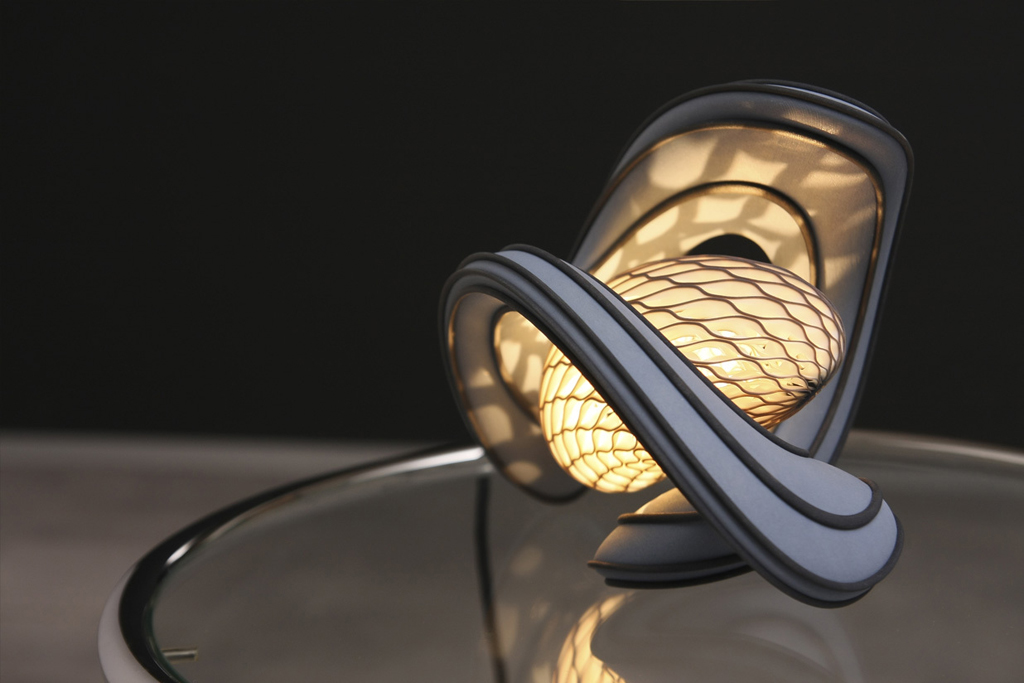
Art-pieces are often illuminate by spotlights. These spotlights create an egg-shaped light pattern on the art object and it’s surroundings. It results in a lack of uniformity in light intensity and that the art piece is illuminated suboptimal.
‘Raybender’ Art Illumination System by TU Delft Student R. Baldewsing
The Raybender lighting system was designed to enhance the flexibility in designing a tailored illumination pattern for any art lighting solution. It makes use of a customized optic to control the light.
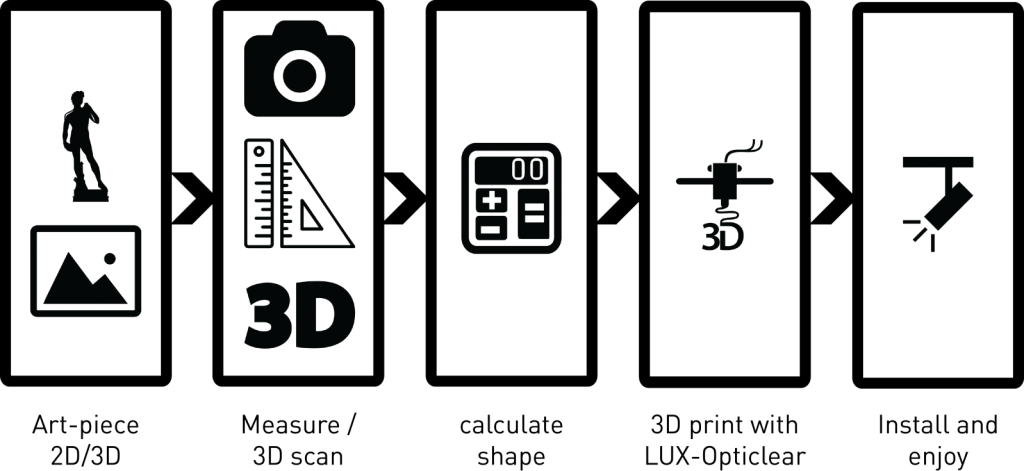
The lighting system has a modular design and replacing a part is quite easy. By scanning the art object calculations can be made to tailor the shape of the light. The whole lighting system is designed to easily replace old spotlights.
3D Printing Lighting Inspiration
You will find ‘Raybender’ and other impressive 3D printing references picked up in the ‘Inspiration‘ page of this website.
Market Leader 3D Printed Optics Enters Next Phase of Technology Development and Application
Luxexcel, the first company that is able to 3D print functional lenses, announced a €7.5 million series B-Round Venture Funding. The first closure is done and the second closure will be finalized in the next 90 days. The B-round was led by the Flemish investment company PMV, which included the firm’s existing investors, SET Ventures and Munich Venture Partners.
Luxexcel is pleased to announce the completion of this B-round funding. The technology and worldwide unique 3D printing service will offer new capabilities and novel optical solutions to many different markets. With these investments, Luxexcel will be able to accelerate the growth of its 3D printing technology platform and develop extensive additional printing capabilities.
B-Venture Funding for optical 3D Printing Technology Development
Enhanced 3D Printing Capabilities
Roald Borré, PMV’s co-Head of Venture Capital, stated “We’re excited to have the opportunity to invest in Luxexcel. We join Set Ventures and Munich Venture Partners in supporting this company with its innovative and unique 3D Printing capabilities. We’re convinced that the company will change the way optics are designed, produced, and digitally stored across many different market segments. Our team is looking forward to help Luxexcel to accelerate the digitization of optics manufacturing”.
Richard van de Vrie, President and founder of Luxexcel is excited about PMV joining Luxexcel. “This strong investor was already successful in developing companies the 3D printing space. It is a great asset to have them on board. I am sure that with these investments Luxexcel will enhance its global leadership position in the Additive Manufacturing of lenses and optical components”.
Lux Opticlear: The next Generation 3D Printed Lenses has Arrived.
Digitally Printed Optics Online Available
Since the launch of the Printoptical Technology in 2010, Luxexcel has raised a total of € 17.5 million in funding. The company has grown to a team of 25 employees and recently started to build an online ordering platform to provide worldwide accessibility of its service, providing optical designers with a rapid path to lens design, prototyping, testing, refinement and manufacturing of custom optical components in a matter of days.
TU Delft Students Develop Unique 3D Printing Concept Incorporating Printed Optics Technology
Recently, Dutch Luxexcel challenged the Industrial Design Bachelor Students of the Delft Technical University, The Netherlands, to create a unique design concept incorporating it’s inventive Printoptical Technology. As a result, a variety of showcases was created by Industrial Design students of Delft University of Technology.
STUTTGART makes it possible to design custom lighting solutions rather than taking just a standard lamp providing interior spaces with light. Alternative solutions may provide a selection of choices only, STUTTGART provides the lighting designer with enhanced freedom in design.
TU Delft – Stuttgart – Pendant Fixture – Exploded View
The concept offers architects and interior designers an innovative lighting arrangement to make unused interior spaces useful again.
TU Delft – Stuttgart – Visual Application in a Pool Environment
STUTTGART parts are printable within Luxexcel’s current framework of capabilities, it is not aimed at future 3d printing developments. The ‘Stuttgart concept’ is ready for market launch!
‘Daylight Underground’ by Martin Kooper
This flat solar collector, as designed for Luxexcel technology, can be used for concentrated solar power (CSP), but also for daylight systems. In the latter case light is guided into a glass fibre, from where it can be transported to spaces where daylight is more scarce. The light can be used for architectural installations, or to augment or replace traditional lighting.
TU Delft – Daylight Underground – Light Guides – Prototype
For this project, application in a subway station was explored, where the light let travellers experience the feeling of the natural light of the sky outside. The designed collecting system is 10 m2 in size and can replace up to 50% of traditional lighting in peak hours.
TU Delft Student Application Award – Daylight in the Underground – Delft Central Station, The Netherlands.
The system can be easily integrated in the landscape if modules can be mounted in all angles and places. Each module comes with an individually customized set of lenses to deal with its different solar incidence. By varying the optical properties of the lenses in the system, different effects can be created.
TU Delft_Application Award – Daylight in the Underground – Rotterdam Blaak Station, The Netherlands.
Different system performance can also be created. One location might have a lot of cloudy days, so the acceptance angle should be larger to capture the more diffuse light. A location with only sunny days could be tailored for maximum efficiency. All implementations require consideration of the earlier mentioned key characteristics.
Fully 3D printed collectors are possible in the near future. Good integration into existing structures will require a unique design per implementation, therefore, mass production will be inefficient. The design could create an entire new field of cost effective daylight, energy savings and creates a possible entry point into the (lucrative) CPV market.
Opportunity for End-use Products by Deloitte University Press
Additive manufacturing (AM), better known as 3D printing, represents an invaluable avenue of exploration and investment for companies end-use products in response to market demands. The emergence of additive manufacturing technologies can lead to exciting opportunities… or obsolescence. Companies can explore four tactical paths as they as they consider evolving their deploy these technologies across their businesses.
Evolving Products to Market Demand
AM technology represents a potentially valuable avenue of exploration and investment for companies as they consider to evolve their products in response to market demands. As the 3d printing technologies continues to improve, its ability to enhance product per formance is expected to continue to increase as well.
Changing Capital vs. Scale Relationship
As this performance increases, AM use is likely to continue to migrate from being an advanced technology used only by innovators to a more commonly used technology for core production activities.
“AM reduces the capital required to achieve economies of scale.
IT increases flexibility and reduces the capital required to achieve scope”
AM reduces the capital required to achieve economies of scale. At the same time, it increases flexibility and reduces the capital required to achieve scope. Changing the capital versus scale relationship impacts companies by presenting choices on how to deploy AM across their businesses.
Deloitte University Press: 3D Opportunity for End-use Products
Recently, 3D Systems released a new Deloitte University Press whitepaper for download, as part of a series on additive manufacturing, to help determine how to incorporate 3D printing into a companies manufacturing proces.
When doing so, it has the potential to enhance the end-use products in the following ways:
•Leveraging increased geometric complexity;
Create objects that cannot be manufactured using conventional manufacturing techniques such as casting, forging and subtractive machining. Innovative 3D printing materials provide high strength, yet are lightweight;
• Decreasing system complexity;
Reduce the number of parts and sub-assemblies by redesigning more effective parts into a single component system;
• Increasing customization;
Create individually customized products without incurring additional set-up costs, molding/tooling and post-processing costs typically associated with mass customization;
• Enhancing product performance;
Design for performance rather than manufacturability, as required by more traditional manufacturing techniques.
The opportunity for companies to apply additive manufacturing in the pursuit of value through improved performance, greater innovation, and accelerated growth will remain for the foreseeable future.
Learn from the movie below how companies can explore four tactical paths as they deploy 3D printing technologies across their businesses.
Online Training Course – AM for Business Leaders
The Deloitte University also launched an online course designed to help expand the knowledge of the business implications of additive manufacturing and to inform about the choices how and where to invest in these 3d printing technologies.
LASER World of PHOTONICS 2015, being held from June 22–25, shed light on the industry. The enormous energy inherent in the topic was tangible at the leading trade fair in Munich: there were around nine per cent more exhibitors (1,227) and more than ten per cent more visitors (more than 30,000) in attendance and a new hall was opened. Concrete applications attracted keen interest with 3D printing applications on the rise!
AM for Production Miracles and More…
Additive manufacturing is used in lightweight construction, dental technology, lighting and medicine: that was demonstrated by various exhibitors as well as by the special show “3DPrinting – Additive Manufacturing”. The two meter high and six meter wide letters “LIGHT” created by Fraunhofer ILT using generative manufacturing symbolized the importance of generative manufacturing processes for lightweight construction. The company Materialise created a stir with a prototype heart from a 3D printer.
Luxexcel 3D Printed Optics as shown by Edmund Optics
In the physical world of optics and photonics – as used in imaging and lighting applications – Edmund Optics showed their custom printed optics lens portfolio created with amazingly progressing Luxexcel Printoptical Technology.
3D Printing affects all Fields of Endeavor
Internet, Smartphone, car, road traffic, aviation, food and beverages, medical operation, disease diagnosis: 3D printing and Photonics are intelligent, is part of our everyday lives and is transforming our world: Both 3D printing and Photonics are fascinating and have truly become game-changing technologies in industry and society.
International Year of Light 2015
The International Year of Light 2015 was a golden thread running not just through the trade fair but also through the World of Photonics Congress in the International Congress Center Munich (ICM).
Laser World of Photonics Conferences with special attention for the International Year of Light 2015
Photonics Industry has Momentum
According to a recent study by the Federal Ministry of Education and Research and trade associations SPECTARIS, VDMA and ZVEI the global turnover of the Photonics industry in 2014 was around 350 billion euros. It is due to hit 615 billion euros by 2020.
Finally, the outlook is good for the next LASER World of PHOTONICS, to be held from June 26–29, 2017.
The TCT 2015 Show + Personalize Conference team has announced the Executive Keynote programme for the 20th edition of the industry-leading 3D technologies event.
The TCT 2015 Executive Keynotes
A variety of leading 3D companies will delegate their executives to join the TCT 2015 keynote program. Among them are Al Siblani, CEO of EnvisionTEC, Scott Schiller, the Worldwide Director 3D Printing at Hewlett-Packard, Max Lobovsky, CEO of Formlabs, Conor MacCormack, CEO of Mcor Technologies, Todd Grimm, President at T. A. Grimm Associates and Andy Middleton, President for the EMEA region at Stratasys.
Fresh Perspectives to the Conference Stages
TCT strive to bring fresh perspectives to the TCT conference stages year-on-year — something that’s made easier by the wealth of talented speakers available and the speed that this fascinating industry is developing. The selected executive keynotes have decades of experience with 3D printing technologies between them but are all poised to have their biggest impacts in the years to come. Long-standing companies like EnvisionTEC, Stratasys and Mcor will share the stage with relative newcomers Formlabs and debutants HP — with Todd Grimm providing the energetic education that he has become famed for.
TCT 2015: Technologies that Matter
The strength of this year’s conference programme perfectly complements the exhibition, which is demonstrably the most comprehensive show floor dedicated to 3D technologies anywhere in the world. From desktop to workshop to production floor, TCT Show 2015 + Personalize is the only place to see all of the technologies that matter.

 Luxexcel and Materialise: A Strong Combination of Hard- and Software